
The Real AI Revolution Isn’t Agents Talking to Humans. It’s Agents Talking With Each Other
When most people imagine the future of AI, they picture smoother conversations between humans and machines.
When most people imagine the future of AI, they picture smoother conversations between humans and machines.
They imagine a chatbot that finally understands nuance. An assistant that books appointments without confusion. A virtual coworker that always gets it right.
And while those improvements matter, they are not the real revolution.
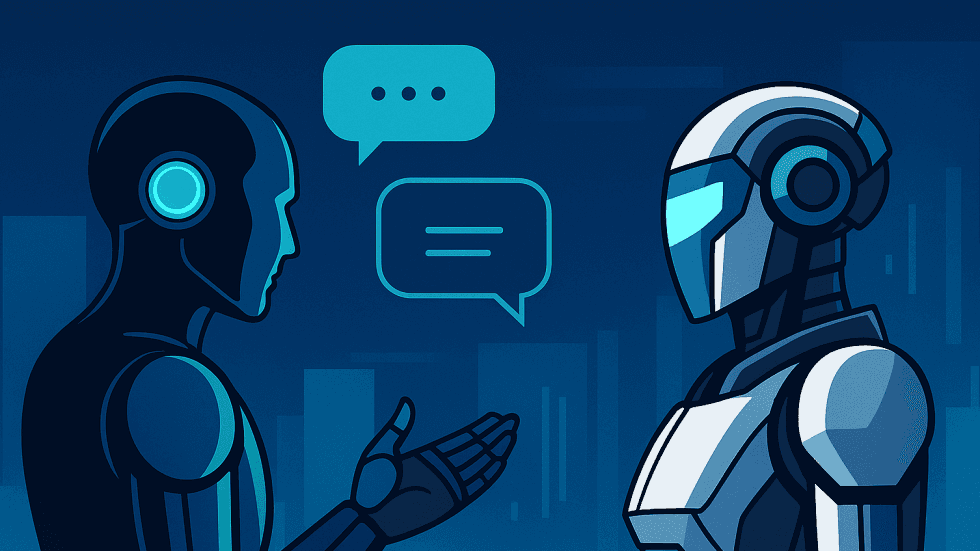
The true breakthrough is unfolding behind the scenes. It is not about how agents talk to people. It is about how they talk to each other.
A Shift From Interaction to Coordination
Agentic AI is evolving quickly. In the early stages, agents were built to serve a single function. They answered questions. They booked meetings. They retrieved data.
But real work is rarely that simple. Tasks are interconnected. Dependencies change. Priorities shift.
That is where multi-agent coordination becomes critical.
The next leap in AI is not just automation. It is coordinated intelligence.
Agents that negotiate. Agents that plan together. Agents that divide and delegate tasks. Agents that make collective decisions, without a human driving every step.
The Two Layers Powering Multi-Agent Work
To make this shift possible, two foundational layers are coming together:
First, there is MCP. That is the protocol layer that lets agents discover and access real-world systems safely. APIs, tools, databases, and workflows — all made accessible through a unified framework.
Second, there is A2A, or Agent-to-Agent communication. This is what allows agents to share goals, understand context, and synchronize actions.
With A2A in place, agents stop behaving like isolated bots. They begin working like teams.
They know when to ask for help. They understand how to trade off responsibility. They can hand off tasks mid-process, or split workloads for parallel execution.
What We Saw at MIT’s Internet of Agents
In April, we attended the Internet of Agents event at MIT. It was one of the most exciting signals yet that multi-agent infrastructure is on the move.
New frameworks are emerging that allow agents not only to communicate, but to transact and evaluate each other’s reliability.
This means agents can develop reputation models. They can learn whom to trust. They can determine when another agent is the better choice for the job.
That kind of logic mirrors real-world collaboration.
And it is exactly what enterprises will demand if they are to embed AI across workflows and departments.
Tools Catching Up to the Vision
Several leading frameworks are already making moves in this direction.
Google’s Agent Developer Kit, CrewAI, LangGraph, and GenKit are beginning to introduce native A2A capabilities. They are starting to treat agents less like tools and more like teammates.
This is a foundational shift in how we think about deployment.
No longer are we placing a single agent inside a system.
We are building systems composed of agents.
How We’re Building for This Future
At EasyBee AI, this is the world we are building toward. Our Hex architecture is already designed with multi-agent coordination in mind. It supports modular task handling, dynamic delegation, and shared state management across agents. We believe mid-sized companies have a real advantage here. With fewer legacy systems, they can deploy agent teams faster. With leaner operations, the ROI is clearer. With more agility, the learning curve is shorter.
The companies that act now will not just benefit from smarter tools. They will be the ones who lead the next phase of work. We are building for that future.
Are you?

