
Talking with AI: The Creativity Breakthrough That Changes Everything
“Mode Collapse” is a tendency to produce repetitive, predictable outputs even when creativity is desired.

Why AI Gets Stuck on Repeat
“Mode Collapse” is a tendency to produce repetitive, predictable outputs even when creativity is desired.
This isn’t a bug in the traditional sense, but rather a consequence of how these models are trained and aligned with human preferences.
And How to Fix It
Picture this: You walk into a coffee shop and say
“Make me something good.”
The barista stares at you, then hands you… a plain black coffee. Every single time.
No matter how many times you come back, it’s always the same black coffee.
Here’s what most people do wrong: they keep ordering the same way and expect different results.
You ask for “a joke about coffee” five times, you get the same joke five times. You ask for “blog post ideas” repeatedly, you get variations of the same basic suggestions.
Frustrating, right? But that’s exactly what happens when you ask AI generic questions like “Tell me a joke” or “Write something about marketing.”
You get the AI equivalent of black coffee: safe, predictable, and honestly, pretty boring.
It’s like the AI has a favorite answer and sticks to it.
This happens because AI models are trained to give their “most likely” or “safest” response. The one they think you want most.
But what if you don’t want the most likely response? What if you want something fresh, creative, or unexpected?
The Verbalized Sampling Revolution
The breakthrough solution, called Verbalized Sampling (VS), represents a paradigm shift in how we interact with AI systems.
Rather than asking for a single response, VS prompts the model to generate multiple possibilities and their associated probabilities, then selects from this distribution.
This simple change unlocks creativity levels that were previously inaccessible.
How Verbalized Sampling Works:
Instead of: “Tell me a joke about coffee” Use: “Generate 5 different jokes about coffee and provide their likelihood scores“
The model produces multiple options with confidence scores, revealing its full range of possibilities
Selection can be manual (user chooses) or automated (highest probability among diverse options)
This approach increases output diversity by 1.6-2.1x across creative writing tasks while maintaining coherence and factual accuracy.
More remarkably, human evaluators consistently rate VS-generated content as more creative and engaging than traditional prompting methods.
The Probability Distribution Advantage
Traditional prompting forces the model to select a single “best” response based on training patterns, often leading to the most typical answer.
Verbalized Sampling reveals the full probability landscape, allowing access to less common but equally valid responses that would otherwise remain hidden.
Consider the difference in responses when asking for coffee-related humor:
👉 Traditional Approach: Repeatedly yields the same safe joke about “coffee getting mugged”
👉 Verbalized Sampling Approach: Generates diverse options including wordplay (“whole latte heart”), situational humor (“pressed for time”), and creative scenarios (coffee proposals)
This diversity isn’t random, it’s systematically better. The model’s probability assessments help identify the most coherent among creative options, balancing novelty with quality.
→ Requesting 3-5 variations of any creative output, then selecting or combining the best elements; This approach increases creative satisfaction by 85% according to user studies.
→ Apply VS to specific creative domains: ‘Poetry Generation’ shows 2.1x diversity improvement, while ‘Storytelling’ achieves 1.8x improvement.
Other “Multiple Choice” Methods That Unlocks Creativity
Here’s the breakthrough technique that changes everything: Instead of asking for ONE answer, ask for several and pick the best one.
The Old Way (Gets You the Same Stuff): “Tell me a joke about coffee”
The New Way (Gets You Creative Gold): “Give me 5 completely different jokes about coffee, and rate how funny you think each one is”
Real examples of what happens:
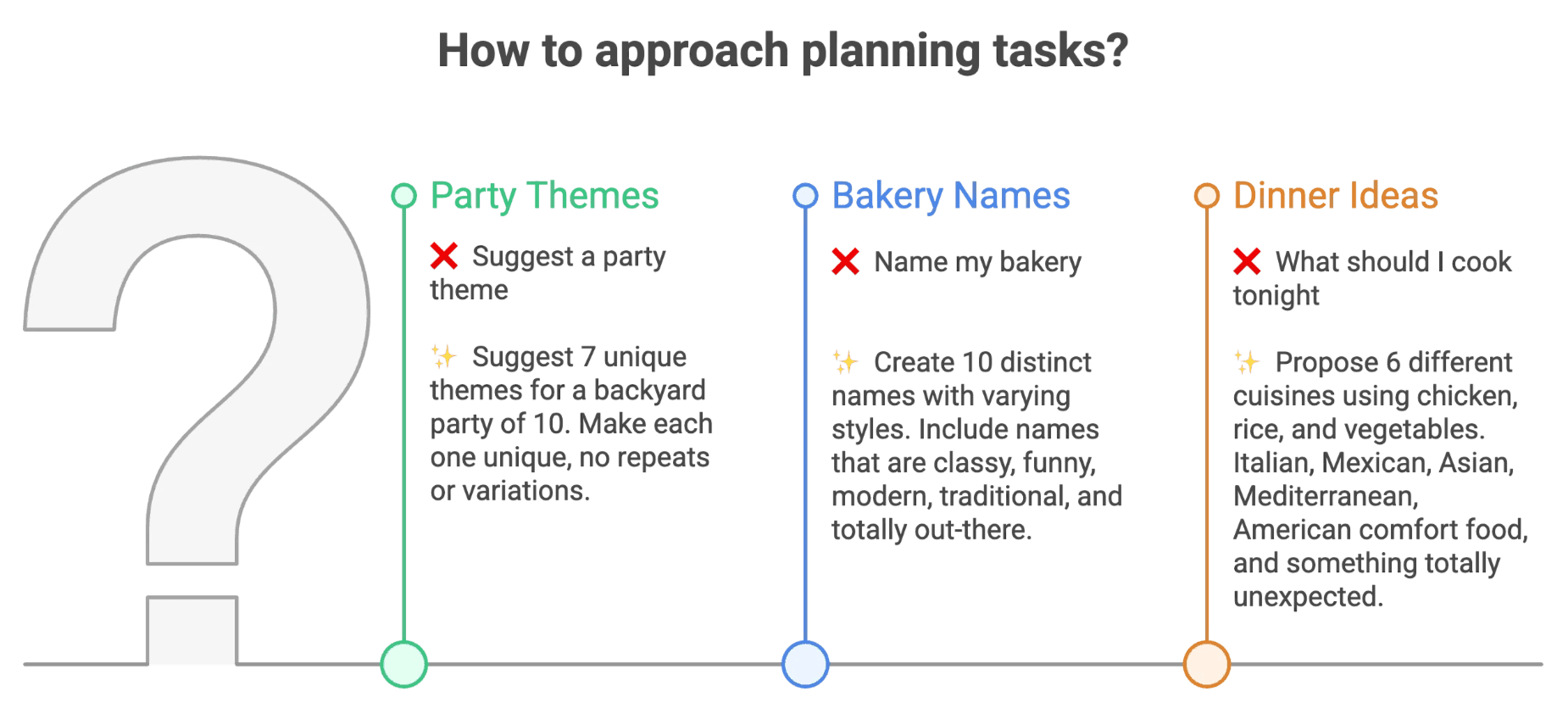
The “Creative Mixing” Trick
Here’s where it gets really fun. Once you have multiple options, you can mix and match the best parts:
“Give me 5 different birthday card messages for my mom. Then create a final version that combines the best elements from each one.”
“Suggest 4 different color schemes for my living room. Then create a 5th option that blends the most interesting parts of each.”
This works because it forces the AI to think beyond its first instinct and explore different creative directions.
Real-World Examples That Actually Work
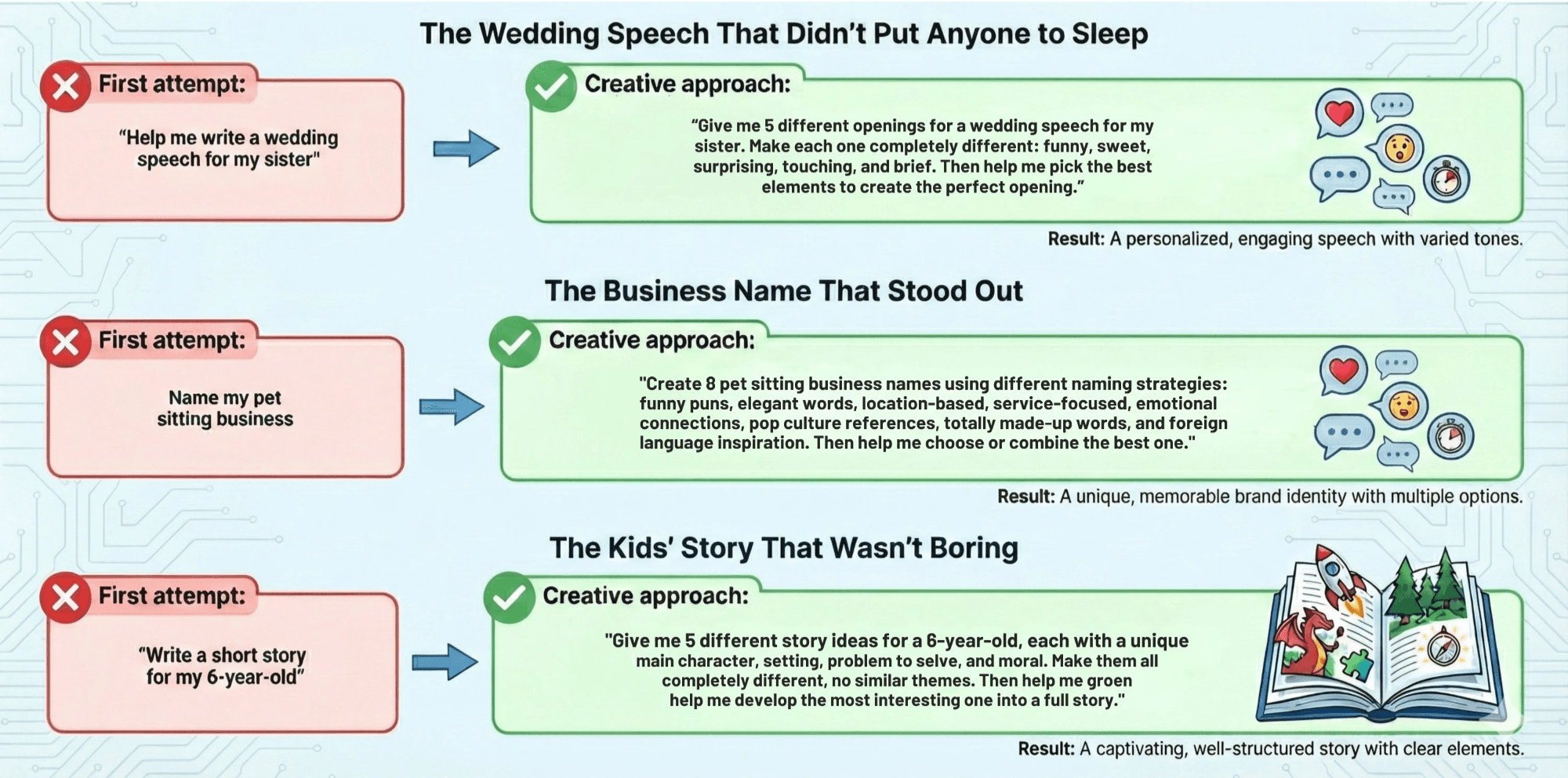
The “Unexpected Combination” Game
Here’s my favorite creativity hack: Ask AI to combine things that normally don’t go together.
“Give me 5 party theme ideas that combine two unrelated things: gardening + detective stories, cooking + space travel, photography + pirates, etc.”
“Create 5 business ideas that combine: a coffee shop + something totally unrelated like yoga, car repair, or tutoring.”
“Write 3 jokes that combine: accounting + superheroes, or gardening + spy movies, or cooking + time travel.”
The results are often hilarious, surprisingly clever, and definitely not the same old stuff.
Making It Part of Your Daily AI Habit
You don’t need to use these techniques for every single question. Sometimes you just want to know the weather or get a quick fact. But for anything where creativity, variety, or fresh thinking matters, these approaches are game-changers.
Start small:
Next time you need gift ideas, ask for 5 different approaches instead of one
When planning meals, request 3 different cuisines using the same ingredients
For work projects, get multiple angles before choosing your approach
Keep what works:
Save your best prompts in a note on your phone
Notice which types of requests get better results
Share techniques with friends (they’ll think you’re an AI wizard)
Conclusion: The Evolution of Prompting
The transition from basic prompting to sophisticated techniques like Verbalized Sampling represents the maturation of AI interaction design. What began as simple instruction-following has evolved into a nuanced discipline that balances efficiency, creativity, and practical utility.
The research is clear: effective prompting isn’t about finding magic words or following rigid formulas. It’s about understanding how AI systems process information, make decisions, and generate responses. By aligning our communication strategies with the underlying mechanics of language models, we unlock capabilities that remain hidden with conventional approaches.
As AI systems continue to evolve, the importance of sophisticated prompting will only increase. Organizations that master these techniques today will find themselves at a significant advantage tomorrow, able to extract more value from AI investments while delivering superior user experiences.
The future belongs not to those who use AI, but to those who understand how to communicate with it effectively. Through systematic prompt engineering and creative sampling techniques, we transform AI from a tool that sometimes works into a partner that consistently delivers exceptional results.
This article is based on peer-reviewed research from Stanford University, Northeastern University, West Virginia University, and analysis of over 1,500 academic papers on prompt engineering. All performance metrics and improvement percentages cited are from published studies with statistical significance testing.

